

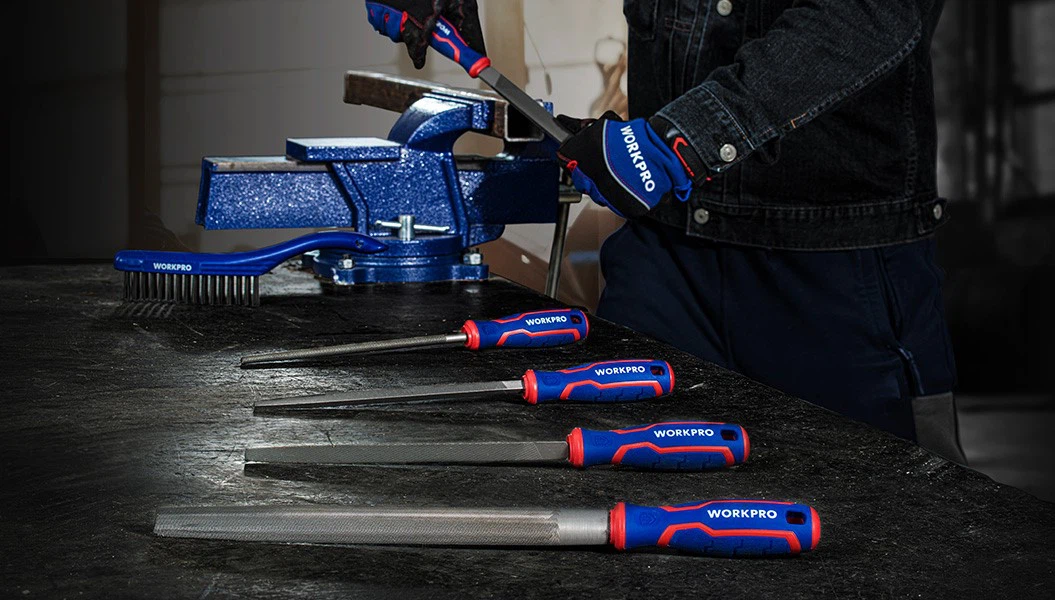
The file is common hand-cutting equipment in the garage. It's made of sturdy steel and has teeth set at an angle. Metals can be sliced, smoothed, or shaped to fit with this tool. It can be used to file or cut mild steel and other soft metals. A portion of it looks like this in Fig. The sharp tip of the touch is attached to the grip. The focus should be on the end of the touch that is not being used. The heel is situated near the grip. The side of a file that does not have teeth is the safe side. The shape of its sections and the style of its teeth both play a role in its classification.

Click for more: WORKPRO 5PC FILE TOOL SET
Types of Files Tools:
1. Shape-Based Classification
File tools are split into several sorts. One of these is size classification:
- 1.1.Flat File
A file with a rectangular cross-section is referred to as a flat file. This utility is designed a little differently in that it reduces the file's width and height. Normal cleaved teeth are sliced on the sides, while double-dented teeth are cut on the face. These are the instruments used to minimize flat surfaces by filing and completing pieces of work.
- 1.2. Hand File
A hand file is comparable to a flat file in that they are both used to fill the inner right-angle side of a task. A safe edge file is another name for this form of a hand file.
- 1.3. File for Knife Edges
Knife-edge files are utilized when a sharp file is required. This type of mechanical gadget has a form comparable to the edge of a knife. The thin edges are normally at a 10° angle. They are also used to fill small grooves and grooves with an angle of less than 60°. Knife-edge files are often used to produce keys in the lock business.
- 1.4. The Round File
As the name implies, these are the types of files that have a round section. Scrub or polish tiny diameter keyholes using this type of file.
- 1.5. File Half-Round
Half-round files are present on the edge and are curved on the other side. The double-cut dents on it, on the other hand, are carved like a circular file and then taped. This sort of mechanical equipment is mostly used to repair and relocate damaged holes.
- 1.6. File Triangle
The size of these files is indicated by the name. The file slot contains 60-degree angles. This file is primarily used for square and rectangular work ranging from 60°-90° angle to complete the filing of the V slot task. These files are also referred to as three-class files.
- 1.7. The Square File
These files are square in shape and rather thin. This type of file is used to create filing slots in rectangular, square grooves, and keyways.

2. Classification Based on Grade
Files are also categorized by the categories of grades. Here are some of the most frequent file kinds, organized by grade. Continue reading to discover more about these types of files:
- 2.1. Rough File
These are the files that include a huge number of teeth of a few sizes. Round files are used to cut soft materials since their cutting is too rough, and they cannot be used to cut hard metals.
- 2.2. The Smooth File
The smooth file is used on numerous websites where the purpose is to achieve a smooth surface. These files are used to make the surface relatively smooth and for precision sizing work by filing.
- 2.3. Dead Smooth File
The Dead Smooth File's teeth are arranged in such a way that they rub against the metal in extremely little amounts. These mechanical instruments are used to add gloss to the job once it has been finished.
- 2.4. Second File Cut
The second cut file is referred to as a file with a medium range. This sort of file is most typically used for filling purposes to reduce the size of the job.
When this sort of file is compared to the bastard file, it is discovered that the filing is done with this file to make the surface plain.
3. Cut-Based File Classification
Cuts are also used to categorize files. Here are some of the most frequent file kinds, organized by cut type. Continue reading to discover more about these types of files:
- 3.1. File with a Single Cut
A single-cut file is a machine tool with parallel lines of teeth that run diagonally across its face and only in one direction. The metal surface is thoroughly rubbed with a tiny amount, resulting in a smooth surface. As a result, these are the tools used for polishing hard metals as well.
- 3.2. File Spiral Cut
These files have teeth that are carved into round or semi-round shapes. A spiral-cut file's teeth are thread-like in form.
- 3.3. The Rasp Cut File
A rasp-cut file is a file with very coarse teeth. Teeth that are triangular in shape and protruding are examples of this type. These are tools for working with wood, plastic, fibre, hard rubber, and animal horns and hooves.
- 3.4. File with two cuts
A double-cut file is one in which two rows of teeth cross each other at an angle of 40°-45°, while the other row has an angle of 70°-80°. Because of the two teeth, it is positioned this way. This file is responsible for quickly cutting metal; however, it cannot make the surface smooth. This type of file, commonly known as a rough file, has an angle of 30° to 35° on one line and an angle of 80° to 87° on the other.
- 3.5. File with a Curved Cut
Curved cut files, also known as Vixen files, are commonly used to fill large surfaces of soft metals like aluminium, zinc, copper, and brass.
4. Other File Types Tool
In addition to the above-mentioned file types. Other common file types are described in depth. Continue reading to discover more about these file types:
- 4.1. Barrett Files
Barrett files are narrow in both width and thickness, with a rounded point at the end. Only the flat side of these files is cut, while all other sides are left intact to conduct the levelling process.
- 4.2. File Checking
Checking files are parallel in width and gradually thin in thickness. The teeth in these mechanical devices are cut in a precise grid pattern, which is utilized to make serrations and perform checking operations.
- 4.3. Crochet Files
Crochet files are thin in width and steadily thinner in thickness, cut all the way around, and have two flat and one radiused edge. This mechanical device is usually used for filing junctions on flat or curved surfaces, as well as in slots with rounded corners.
- 4.4. File Crossing
Crossing files are half-round on both sides with a bigger radius on one side than the other, as well as being thinner in width and thickness to fill the curved interior surfaces. The filing procedure is enabled by a double radius at the intersection of two curved surfaces or a straight and curved surface.
- 4.5. Files for Dreadnought and Millen cut
Dreadnoughts are files with highly undercut, sharp yet coarse teeth, whereas millennials are files with straight teeth. Both of these files are used to remove huge amounts of material from thick aluminium alloys, copper, or brass in a short amount of time. Millennium and Dread knot is the most recent instruments for removing plastic filler materials typically used in vehicle body restoration, such as two-part epoxy or styrene.
- 4.6. Equalling Files
Equaling files have widths and thicknesses that are nearly parallel. These are mechanical tools that are mostly used to fill slots and corners.
- 4.7. Rasp the Farrier
Farrier rasps are sour rasp files that are usually used by barbers and blacksmiths. They're used since they're flat on one side and have a double cut on the other.
- 4.8. Files with columns
Pillar files are parallel in width and thin in thickness, and they are used for precision flat filing work. For safe, long, and precise work, double cuts along both the top and bottom sides are ideal.
- 4.9. The Pippin Files
Pippin files are tapered files with a teardrop cross-section and the edge of a knife file. This gadget is used to create V-shaped slots by filling the intersection of two curved surfaces.
- 4.10. Float Files for the Planner
The only straight and single-cut files found thin are Plane maker’s floats. These tools are used to cut, flatten, and smooth wood, particularly in the manufacture of wooden hand planes.
- 4.11. Parallel Files in Rounds
Round parallel files are identical to round files in many ways, except they do not taper. These are jagged cylinder-shaped files.
- 4.12. Files for Sharpening Saws
Saw sharpening files are typically single-cut for a smooth finish. Jigsaw sharpening files have been discovered to be ideal for sharpening saw blades. Chainsaw files, for example, are primarily used to sharpen chainsaws. These have a rounded cross-section but are designed to fit against the cutting edge of chainsaw teeth.
- 4.13. The Fret Files
Freight files have three flat sides and a concave groove on one side. Luthiers employ mechanical tools of this type to record around the crown on the frets of guitars and other instruments. The flat surface of such files is used to prepare the fret ends by eliminating the sharp edges that remain after the frets have been trimmed to the necessary length.
- 4.14. Ring Files Half Round
Half-round ring files are smaller in width and thickness than ordinary half-rounds. These are the files that are utilized to clean up the inside of the rings.
- 4.15. Files with Joint Round Edges
Joint round-edge files are ones with rounded edges that are parallel in width and thickness. Flat safes with no teeth and only rounded edges can be found. These mechanical devices are used to create joints and hinges.
- 4.16. Knife Files
Knife files are tapered in width and thickness, with the edge of the knife being the same thickness throughout and the entire length resembling an arc. This file format is used for slotting or wedging.
- 4.17. Files for Nuts
Nut files are mechanical tools that are reasonably fine and accurate files in a set of graduated thicknesses and are mostly used by luthiers for dressing the slots at the end of the neck to support the strings of guitars, violins, and other instruments in the correct position.

Frequently Asked Questions (FAQ)
- Files Tools
A file is a tool for removing small quantities of material from a workpiece. It is commonly used in woodworking, metalworking, and other related trades and hobbies.
- Flat File Tool
We provide a comprehensive assortment of Files Tools that are made with high-quality metals and other components sourced from the industry's most reputable sources. To ensure our customers' happiness, we supply the files in a variety of sizes and according to their needs.
- File Hand Tool
It is commonly used in woodworking, metalworking, and other related trades and hobbies. The majority are hand tools composed of a case-hardened steel bar with a rectangle, square, triangular, or circular cross-section and one or more surfaces cut with sharp, often parallel teeth.
- Mechanical File
The file is the most often used hand-cutting instrument in workshops. It's a chunk of hardened high-grade steel with slanting rows of teeth. It is employed in the cutting, smoothing, and fitting of metal pieces. Softer metals are filed or cut using it.
- Tool Types
Power tools and manual tools are the two primary types of tools. Power tools are any tools that use a power source other than human efforts, such as a battery, electricity, gas, or something else.
What Is a Flat File Tool Used For?
To create a bevel on the edge of a piece of metal, any type of hand or flat file can be used. They can also be used to generate convex surfaces and round corners. Smooth, single-cut hand files, with their safe edge, can also be used to file fingernails.
- Rotary File Endodontic
Rotary Files made of nickel-titanium alloy are the most crucial component of root canal equipment. Over the previous three decades, rotary file design has been scientifically enhanced, and rapid progress in manufacturing and knowledge of the Ni-Ti alloy has been made.
- Rasps
A rasp is a coarse file used for shaping wood or other materials. It is typically a hand tool that comprises a commonly tapered rectangular, circular, or half-round sectioned case-hardened steel bar with separate, individually cut teeth