

Mechanics have long been aware of the advantages of impact drivers. Auto repair has utilized pneumatic impact drivers for many years due to its ability to apply tremendous force and torque to the object being driven without transferring force or impact to the operator. This made them perfect for use in tire shops for removing or reinstalling lug nuts, a procedure that was somewhat laborious when performed with a lug wrench but nearly child's play with an impact driver.
Not very long ago, the same technology was tested in cordless drills, resulting in the birth of the cordless impact driver. Today's compact, handheld, cordless impact drivers likely lack the torque to remove and reinstall the lug nuts on your vehicle, but they are highly flexible in the woodshop and around the house.
It's Not a Hammer Drill
Some individuals have a tendency to confuse an impact driver with the hammer drill feature present on many power drills. Although they appear to share a similar motion, their functions are extremely distinct. A hammer drill will move the bit in and out of the hole being drilled (think a bit like a jackhammer), which is great for drilling masonry. In contrast, the action of an impact driver is a high-speed, repeating turn-stop-turn-stop motion. This movement enables the impact driver to generate significantly more torque than a comparable cordless drill, without passing torque to the operator.
Driving Screws
The additional torque produced by the impact driver's action enables the operator to perform more challenging tasks with smaller tools. Using a regular 18-volt cordless drill to drive one three-inch wood screw after another would exhaust the batteries of someone constructing a deck using pressure-treated lumber. A smaller, lighter impact driver not only drives screws more quickly but also requires less effort from both the tool and the operator. After completing the process with a conventional cordless drill, using the impact driver to push three-inch screws feels similar to driving screws into butter.
Drilling With an Impact Driver
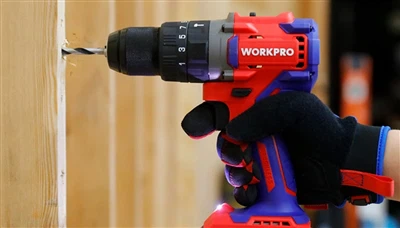
Can an impact driver be used as a drill? Absolutely. Drilling clean holes with a spade bit are significantly easier than using an impact driver. When using a spade bit to drill big diameter holes (1/2-inch and larger, up to around 1-3/8 inches in diameter), the bit can pinch and become stuck in the hole. When the bit becomes caught in the hole with a cordless drill (or worse, a heavy-duty, high-torque power drill), the motor's rotation of the drill bit and chuck is transferred to the body of the drill, twisting it in the user's hands. In the best-case scenario, the drill will slide out of the operator's hands, and in the worst-case scenario, the torque of the rotating drill will be transferred to the operator.
With an impact driver, the likelihood of such an injury is drastically minimized. The start-and-stop motion of the driver's action produces torque in short, strong bursts, so preventing the spade bit from sticking. Even if it does stick, the torque returned to the operator is negligible. This makes the impact driver an ideal tool for electricians and plumbers who must bore many 3/4-inch and bigger holes through studs to create conduits for wiring and pipelines. Using an impact driver for the same task is a blessing for anyone who has suffered from a sprained wrist as a result of constantly twisting a power drill in their hands.
Where's the Chuck?
In most situations, impact drivers lack the normal keyed or keyless chuck seen on conventional corded and cordless drills. The three-jaw slip chuck is replaced with a 1/4-inch hex quick-change chuck. This form of chuck reduces the total length of the driver's body, enabling the impact driver to fit into tighter spaces than conventional drills. It also enables bit changes to be performed considerably more quickly than with a conventional chuck; you simply press in on the outer ring and slide out the previous bit before inserting the new bit into the chuck and clicking it into place.
The disadvantage of a slip-style chuck is that it can only accommodate 1/4-inch hex shank bits. Fortunately, the majority of spade bits and driver bits use this common 1/4-inch hex size, but you will need to save traditional round shank drill bits for your drill or drill press.
Versatility Is the Trump Card
Versatility is the name of the game for impact drivers. A smaller motor (and hence a lighter battery) can deliver greater torque and survive longer between charges than a larger cordless drill due to the impact motion's force. This becomes crucial when utilizing the gadget for extended periods of time. Since the impact driver is smaller than a cordless drill, electricians, plumbers, and carpenters can store it in a pouch on their tool belt rather of carrying it separately. This may not be an essential function in the woodshop, but the additional torque for drilling and driving will be greatly appreciated.
A word of caution when driving screws in delicate woodworking projects with an impact driver Due to the impact driver's higher speed and torque compared to a standard cordless drill or cordless screwdriver, you must be careful not to overdrive the screw heads past the wood's surface. The increased torque of the driver makes it simple to drive a screw head much further than desired.