Drills took care of the holes and that was the end of it. However, now that we have impact drivers, we have more alternatives than we frequently know what to do with. Many folks have recently questioned us about the difference between an impact driver and a drill. In actuality, how and when you utilize an impact driver vs a drill is important. Then there's the decision between utilizing an impact driver and a hammer drill. This raises even more questions. Before you go too far, keep in mind that these instruments use various processes to do tasks. They also favour various uses. Using each instrument correctly gives the highest degree of efficiency, which is why Pros frequently carry more than one tool.
We can provide you with simple answers as well as a more in-depth view of what you need to know as a more sophisticated tool user. This can be useful if you're debating whether to get that two-tool combo package or stick with a basic drill. Examining how manufacturers build these instruments and how they differ should help you decide which you require. At the very most, we can make you sound like you understand what you're talking about when the next tool discounts arrive at Acme Tools, Home Depot, or Lowe's!

BASICS OF IMPACT DRIVER VERSUS DRILL
A drill simply rotates the chuck at the front of the drill. Most chucks are now keyless, which means you don't need that odd-looking key bent to 90 degrees to change the bits. Simply hold a keyless drill chuck and spin one way to loosen and the other to tighten. Ratcheting chucks, for an instance, are robust enough to hold nearly any shape that fits into them, including smooth drill bits.
Many drills offer several speed and torque settings. The specific applications for those can be kept for a later discussion because we just need to understand the basic differences right now.
Impact drivers function similarly to drills in that they spin the bit to which you have attached. When driving a large fastener with a drill, you may reach a point where the drill cannot proceed. It is exerting all of its force and torque, but it is unable to move the huge fastener or bolt. This is where the impact driver comes into play.
They have significantly higher torque.
WHEN MORE TORQUE IS REQUIRED, USE IMPACT DRIVERS.
Consider working on a bolt that is too difficult to loosen with a wrench. You lean on it and tug on it, but it won't budge. You ultimately decide to take a hammer and pound the wrench's handle to get it loose. This provides additional, albeit brief, torque. That's essentially what an impact driver does. However, it can do it thousands of times per minute.

When it becomes stuck, an internal mechanism starts "striking" the chuck to continue driving the screw or tightening/loosening the bolt. In terms of breaking away stuck bolts and screws or driving them deeper into the material, an impact driver is far superior to a drill.
DRILLS PROVIDE MORE SPEED FOR FASTENERS... AT WHAT COST
An impact driver mechanism loses efficiency because it repeats a cycle of the anvil driving the rotation of the chuck. Drills use a steady force to drive the fastener without halting or pulsing. As a result, while impact drivers provide more torque, they tend to move fasteners more slowly. In our drill vs. impact head-to-head comparisons, we've seen this again and time again. A capable drill will almost always sink a ledger screw faster than an impact driver. The only exception is when the torque required exceeds the drill's power to maintain its optimal speed. When this occurs, the drill slows while the impact driver continues to force the fastener into the material.
DRILL CHUCKS VS IMPACT DRIVER
The 1/4′′ quick-lock hex chuck is used by impact drivers. These allow you to insert a hex bit, and some of them automatically lock the bit in place. Other, inferior designs necessitate pulling out the flange to insert the bit. To remove it, pull the chuck out again, and the bit is released. One advantage of this technique is that it allows for a more compact design, which allows you to fit into smaller locations. The disadvantage is that it necessitates the use of a hex bit. These impact-driver hex chucks will not accept round drill bits.
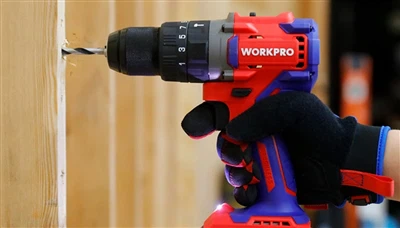
Until recently, drilling a hole required the use of a drill. Drill bits for impact drivers are now available from companies such as WORKPRO. In the industry, there is a push to allow you to use an impact driver for everything that a drill can perform. But be cautious! Impact drivers provide much higher torque than drills, and some applications advocate using impact-rated bits rather than the regular ones that came in that huge set for $19.99 at the beginning of the new year.
However, as more drilling features are added to accessories, some businesses are producing impact drivers with variable speed and torque settings.
WHAT IS ABOUT HAMMER DRILLS?
Hammer drills begin with a standard drilling movement and use the same chuck as drills. The majority of drills allow you to convert between drill and hammer drill modes. The hammer drill, like a drill, can have several speeds. Instead of the impact driver's hitting action working in the same direction as the chuck rotates, the hammer drill works by rotating the bit and "hitting" the bit forward in the same way a hammer would. Consider using a drill while rapidly pounding the rear of it with a hammer.

When working with concrete, masonry, stone, and other similar materials, hammer drills perform well. There is no advantage to using the hammering motion to drive into wood or drywall.
In reality, pounding can often cause damage to softer materials. When drilling into materials that do not require hammering, all hammer drills operate with the hammering mechanism switched off.
WHEN SHOULD A DRILL, IMPACT DRIVER, OR HAMMER DRILL BE USED... MAKE IT EASY FOR ME!
When Using a Drill
- · Screwing into the wood, drywall, and other soft materials
- · Tightening/loosening bolts that do not require a lot of torque
- · Drilling holes in soft materials such as wood and drywall
When using impact drivers
· Screwing screws into wood or metal (or drywall if you have a lower speed/torque option)
· Large diameter screws or lag bolts must be driven.
· Bolt tightening/loosening, particularly those that should be extremely tight or have been jammed
· Drilling holes in wood, drywall, or metal with newly designed impact-driven drill bits
When using a Hammer Drill
· Hole drilling in concrete, masonry, or stone (in hammer drill mode)
· Screwing in the wood, drywall, and other soft materials drill-only mode)
· Bolt tightening/loosen drill-only mode)
· Drilling holes in soft materials such as wood and drywall (in drill-only mode)
WHICH DRILL, IMPACT DRIVER, OR HAMMER DRILL SHOULD I GET?
Because there are so many diverse needs out there, this is a difficult topic to answer. If you only buy one product, I recommend the impact driver. New bits enable you to do all that a typical drill can do. You're simply missing out on the hammering action that improves drilling in concrete or masonry.
If you can afford a two-tool kit and know (or suspect) that you will need to drill into concrete or stone, go with an impact driver/hammer drill combo. Even without the special bits, the hammer drill should include a drill-only mode that allows it to function just like a drill, and you'll have the impact driver for when you need additional torque with nuts/bolts and lag bolts. If you're not going to be working with masonry, stick with a drill/impact driver kit.
IN REAL-WORLD APPLICATIONS, IMPACT DRIVERS VS. DRILLS
I've had the opportunity to use these tools on several recent projects. For example, we collaborated with a local church to construct a wheelchair ramp. We only required drill-to-drill pilot holes and drive screws. So, for projects like building a deck or erecting a wood fence, a drill is an excellent choice.
We needed to anchor the ramp to concrete at the end, so we used a hammer drill to make the holes before driving the Tap cons into position. A hammer drill is the best tool for drilling a tiny hole in the concrete. Large holes are often drilled with a rotating hammer.
Surprisingly, when utilizing multi-purpose bits, impact drivers perform well at producing smaller holes in concrete. I'd limit their use to holes smaller than 3/8-inch in diameter. I just assembled a grill and used my impact driver to check that every connection was tight. Impact drivers are frequently used by mechanics to tighten and loosen nuts on engines. A lot of gas engine machinery, such as mowers and trimmers, will require the use of an impact driver (or impact wrench) to properly tighten and loosen nuts. An impact tool is required if you use bolts on metal or drive a screw into metal.
OUR INDIVIDUAL PREFERENCES
The impact driver is my go-to tool for the most part. I have a hammer drill/impact driver set available to satisfy all of my drilling and driving needs. Do you have any further questions? Ask us! We enjoy assisting others in understanding the tools we enjoy and how to effectively use them!
WORKPRO Tools Reviews can be found on Facebook, LinkedIn, and Instagram. @WorkproToolsGlobal